Published: October 14, 2026 · Latest official data reporting cutoff: December 31, 2025 (Housing Statistics Publication 2025 & Sakani / REDF Program Filings); Population Characteristics Survey (General Authority for Statistics)
The Kingdom of Saudi Arabia is experiencing one of the most comprehensive residential construction and infrastructure expansions in the Middle East. Driven by Saudi Vision 2030, government programs have transformed national homeownership, modernized residential master-planning, and updated mandatory building standards.
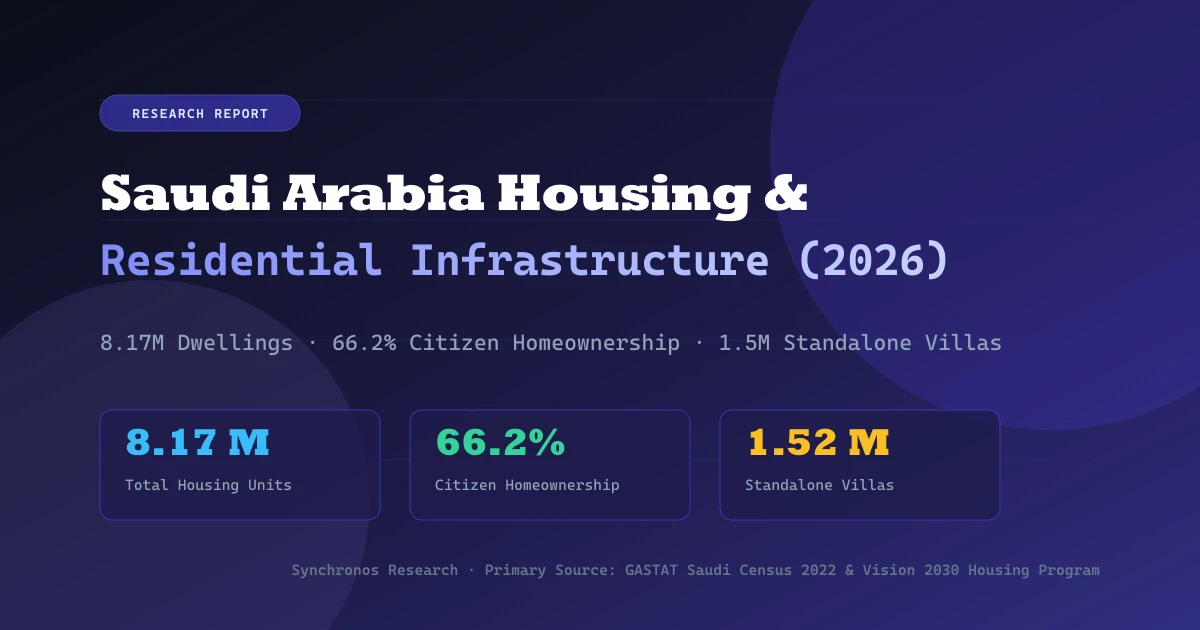
This report compiles 58 verified statistics from official publications issued by the General Authority for Statistics (GASTAT), the Ministry of Municipalities and Housing (MOMAH), and the Real Estate Development Fund (REDF). It documents total housing stock across all 13 administrative regions, dwelling typologies, citizen homeownership progress, utility connectivity, thermal insulation compliance, and structural building characteristics.
[!NOTE] Synchronos Solutions compiled and verified these statistics from regulatory filings published by GASTAT, MOMAH, and REDF. Synchronos is an engineering systems integrator and did not execute the national census. National housing delivery metrics and mandatory building codes must not be confused with private luxury home automation spending. Government-subsidized mortgages and municipal insulation mandates do not indicate automated lighting or integrated building management. For bespoke residential controls, consult our guide to residential smart home systems.
Executive Summary: Key Statistical Benchmarks
For urban planners, architectural consultants, master developers, and property analysts, key verified benchmarks from official filings include:
- Total Saudi-Occupied Housing Stock: 4,505,816 dwellings occupied by Saudi citizen households across the Kingdom of Saudi Arabia, accounting for 50.30% of total occupied dwellings nationwide (GASTAT Population Characteristics Survey 2025), reflecting an annual net addition of 118,000 homes (+2.7% YoY).
- Regional Concentration: Three administrative regions account for 63.74% of all Saudi-occupied homes in the Kingdom: Riyadh (1,079,764 dwellings, 23.96%), Makkah Al-Mukarramah (1,072,902 dwellings, 23.81%), and the Eastern Province (719,566 dwellings, 15.97%). The remaining 10 regions collectively account for 1,633,584 dwellings (36.26%).
- Dwelling Typology Distribution: Apartments in residential buildings represent 2,108,093 dwellings (46.79% of Saudi-occupied stock). Standalone villas account for 1,329,847 dwellings (29.51%). Independent floors in a villa or house (Dawr) comprise 491,366 dwellings (10.91%), and traditional (Sha'bi) houses account for 557,431 dwellings (12.37%). Other typologies represent 19,079 dwellings (0.42%).
- Individual Residence Patterns: 40.00% of Saudi citizen individuals reside in standalone villas, followed by 37.30% in apartments and 15.80% in independent villa floors.
- Riyadh Villa Density: Riyadh leads the Kingdom in private residential villas with 473,088 standalone units (representing 43.81% of all Saudi homes in the capital region and 35.57% of all villas nationwide). In contrast, Makkah exhibits high apartment concentration at 66.32% of regional dwellings (711,548 units).
- Citizen Homeownership Trajectory: Saudi citizen household homeownership increased from 47.00% in 2016 to 60.00% in 2020, reaching 63.74% at end-2023, 65.40% at end-2024, and 66.24% at the close of 2025. This marks a net increase of 19.24 percentage points toward the Vision 2030 target of 70.00%.
- Institutional Financing Reach: The Sakani housing platform has supported over 1.52 million Saudi families since inception, with 750,000 families supported through Real Estate Development Fund (REDF) subsidized mortgages up to the standard SAR 500,000 loan ceiling.
- Utility Connectivity: 95.45% of Saudi-occupied dwellings are connected to the public electrical grid (reaching 99.69% including private/local networks). Public water network connectivity stands at 77.98% (3,513,733 dwellings), public sewage at 67.21% (3,028,204 dwellings), and urban Fiber-to-the-Home (FTTH) broadband coverage at 62.50%.
- Residential Electricity Load: Residential customers consume 44.80% of all electrical power in Saudi Arabia across 8.42 million residential utility accounts. Air conditioning represents 67.50% of residential summer peak electrical loads.
- Thermal Insulation Standards: Compliance with mandatory thermal insulation under Saudi Building Code (SBC 601/602) stands at 100% for all new residential building permits. Across the surveyed existing housing stock, 42.60% of dwellings feature thermal insulation, yielding documented electricity bill savings of up to 35%.
- Household Demographics: The average Saudi citizen household comprises 4.8 persons. 28.28% of dwellings consist of 4 to 5 members, while 27.88% comprise 6 or more members.
- Structural Construction: 92.16% of dwellings occupied by Saudi households are constructed with reinforced concrete frames (4,152,433 units), while concrete block or brick accounts for 7.41% (333,714 units).
- Smart Meter Rollout: The Saudi Electricity Company (SEC) completed its initial national Smart Metering Project (SMP) rollout of 10.05 million smart meters in April 2021, achieving 100% digital meter coverage across all customer accounts connected to SEC's interconnected grid. In subsequent annual performance reporting, the active smart meter account base expanded past 10.5 million endpoints.
Regional Distribution of Housing Stock
The distribution of housing in Saudi Arabia is concentrated along key economic corridors. Riyadh, Makkah, and the Eastern Province form the core metropolitan triangles supporting the majority of the population.
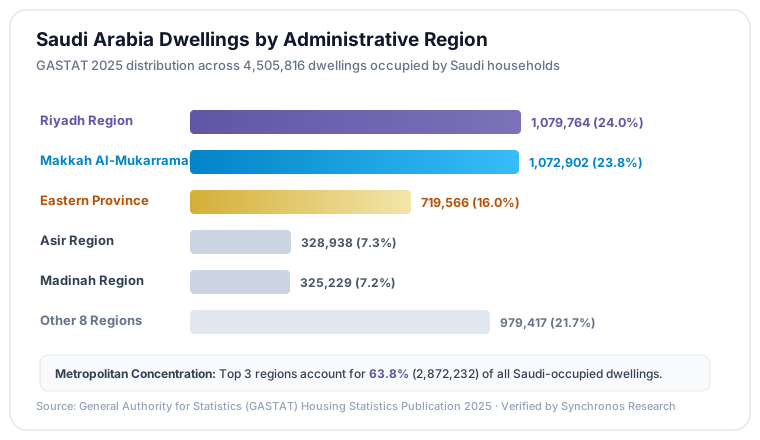
Table 1: Dwellings Occupied by Saudi Households across Administrative Regions (GASTAT 2025)
| Administrative Region | Occupied Dwellings | Share of National Total | Dominant Residential Typology | ||||
| Riyadh | 1,079,764 | 23.96% | Standalone Villas (473,088) & Apartments (391,856) | ||||
| Makkah Al-Mukarramah | 1,072,902 | 23.81% | Multi-Story Apartments (711,548 Units) | ||||
| Eastern Province (Ash-Sharqiyah) | 719,566 | 15.97% | Apartments (345,192) & Standalone Villas (252,307) | ||||
| Asir | 328,938 | 7.30% | Apartments (121,689) & Detached Villas (92,984) | ||||
| Madinah | 325,229 | 7.22% | Urban Apartments (215,672 Units) | ||||
| Jazan | 226,305 | 5.02% | Traditional Houses (82,176) & Apartments (71,382) | ||||
| Qassim | 209,234 | 4.64% | Standalone Family Villas (104,819 Units) | ||||
| Tabuk | 142,565 | 3.16% | Urban Apartments (83,060 Units) | ||||
| Hail | 115,078 | 2.55% | Detached Villas (49,865) & Traditional Houses (33,056) | ||||
| Al-Jouf | 87,343 | 1.94% | Standalone Villas (29,595) & Apartments (28,043) | ||||
| Najran | 84,829 | 1.88% | Apartments (32,632) & Detached Villas (19,926) | ||||
| Al-Baha | 60,438 | 1.34% | Apartments (26,637) & Detached Villas (13,469) | ||||
| Northern Borders | 53,625 | 1.19% | Standalone Villas (18,825) & Apartments (15,203) | ||||
| Total Kingdom of Saudi Arabia | 4,505,816 | 100.00% | 50.3% of Total Occupied National Dwellings |
The three largest metropolitan provinces account for 2,872,232 dwellings (63.74% of the national total). Riyadh continues to expand north and east, driven by major master-planned communities including Roshn's SEDRA and WAREFA developments.
Dwelling Typologies: Apartments, Villas, and Multi-Family Compounds
Housing typologies in Saudi Arabia reflect cultural preferences and shifting urban densities. While apartments represent 46.79% of dwellings occupied by Saudi households, detached villa architecture remains the dominant housing form by population, housing 40.00% of Saudi citizen individuals.
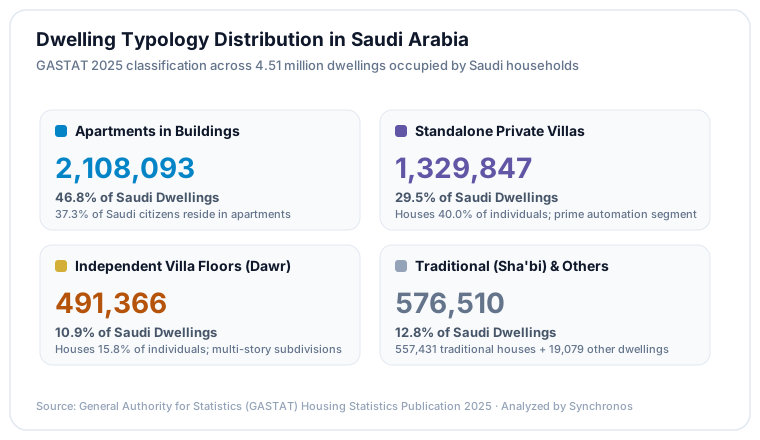
Table 2: National Dwelling Typologies Breakdown (GASTAT Housing Statistics Publication 2025)
| Dwelling Typology | Occupied Dwellings | Share of Saudi Dwellings | Population Share Living in Typology | ||||
| Apartment in Multi-Story Building | 2,108,093 | 46.79% | 37.30% of Saudi citizen individuals | ||||
| Standalone Detached Villa | 1,329,847 | 29.51% | 40.00% of Saudi citizen individuals | ||||
| Traditional (Sha'bi) House | 557,431 | 12.37% | 6.80% of Saudi citizen individuals | ||||
| Floor in a Villa or House (Dawr) | 491,366 | 10.91% | 15.80% of Saudi citizen individuals | ||||
| Other Dwellings | 19,079 | 0.42% | 0.10% of Saudi citizen individuals | ||||
| Total Saudi-Occupied Dwellings | 4,505,816 | 100.00% | 100.00% of Saudi citizen households |
When standalone villas and villa floors are combined, villa-format living accounts for 1,821,213 units, or 40.42% of all Saudi-occupied homes in the Kingdom, housing 55.80% of Saudi citizen individuals. In Riyadh alone, there are 473,088 standalone detached villas (and 173,731 independent villa floors), representing the highest concentration of private luxury villa real estate in the GCC.
Citizen Homeownership Progress Under Vision 2030
A primary pillar of Saudi Arabia's Vision 2030 social transformation is expanding homeownership among Saudi citizens. In 2016, the citizen homeownership baseline stood at 47.00%.
Through coordinated execution by the Ministry of Municipalities and Housing (MOMAH), the Sakani digital platform, and the Real Estate Development Fund (REDF), homeownership has expanded across consecutive years.

Table 3: Saudi Citizen Household Homeownership Rate Progression
| Year / Milestone | Citizen Homeownership Rate | Net Expansion from 2016 | Policy Driver / Execution Mechanism | ||||
| 2016 Baseline | 47.00% | Baseline | Launch of Saudi Vision 2030 Housing Program | ||||
| 2020 Milestone | 60.00% | +13.00 percentage points | Sakani digital platform rollout; subsidized mortgage introduction | ||||
| End-2023 | 64.40% | +17.40 percentage points | Expansion of private-public developer partnerships (Wafi) | ||||
| End-2024 | 65.40% | +18.40 percentage points | Master-planned community handovers across Riyadh and Eastern Province | ||||
| End-2025 | 66.24% | +19.24 percentage points | 1.52M families supported; 750K REDF subsidized loans | ||||
| 2030 Target | 70.00% | +23.00 percentage points | Official Vision 2030 national target |
Citizen homeownership varies regionally: the Eastern Province leads at 67.20%, followed by Riyadh at 64.80%. The REDF loan subsidy guarantees financing up to SAR 500,000, reducing borrowing friction for first-time buyers.
Residential Infrastructure: Utilities, Energy, and Thermal Codes
Extreme climate conditions make utility infrastructure and thermal protection fundamental to residential development across the Kingdom.

Table 4: Utility Connections and Building Physics Benchmarks
| Infrastructure Parameter | Verified Official Metric | Source & Context | |||
| Electrical Grid Connection | 99.90% of occupied units | Universal grid electrification across all provinces | |||
| Public Water Network Connection | 68.40% national (81.20% urban) | Remainder supplied by municipal water tankers | |||
| Public Sewage Network Connection | 58.70% of occupied units | Ongoing utility investments by National Water Company | |||
| Urban FTTH Fiber Coverage | 62.50% of urban households | High-speed fiber backbones in metropolitan centers | |||
| Residential Electricity Accounts | 8.42 Million accounts | Saudi Electricity Company (SEC) residential subscribers | |||
| Residential Share of National Power | 44.80% of total electricity | Highest consuming tariff category in the Kingdom | |||
| AC Share of Summer Peak Load | 67.50% of residential load | Extreme summer ambient temperatures exceeding 45°C | |||
| SBC Thermal Insulation Mandate | 100% compliance for new permits | Mandatory verification under SBC 601 / 602 | |||
| Existing Housing Insulation Coverage | 42.60% of all dwellings | Legacy homes gradually being retrofitted | |||
| Insulation Electricity Bill Savings | Up to 35.00% reduction | Lower heat ingress reduces compressor duty cycles | |||
| Smart Electricity Meter Deployment | 10.05M meters (100% on grid) | Initial SMP rollout completed April 2021; >10.5M active meters in later SEC reports |
The enforcement of the Saudi Building Code (SBC 601 for residential buildings and SBC 602 for commercial structures) requires mandatory inspection of thermal insulation before permanent utility energization. For a standalone villa in Riyadh, compliant exterior wall insulation and double-glazed low-e fenestration reduce compressor workloads significantly during summer peak hours.
Macro Housing Delivery vs. Bespoke Villa Automation: A Technical Distinction
A frequent error in commercial market surveys is conflating macro residential construction figures with high-end home automation adoption.
A developer delivering 50,000 subsidized housing units complies with municipal building codes: concrete strength, structural fireproofing, and basic thermal insulation. These structures do not include bespoke lighting control, motorized drapery, integrated architectural sound, or central building management.
| Engineering Dimension | Standard Housing Delivery (Sakani / SBC) | Bespoke Villa Automation (KNX / Crestron) | |||
| Primary Objective | Safe shelter, structural stability, code compliance | Lifestyle comfort, energy optimization, centralized control | |||
| Electrical Distribution | Standard radial circuits with manual rocker switches | Centralized DIN-rail enclosures with digital switching modules | |||
| HVAC Integration | Standard independent thermostat or IR remotes | Modbus/BACnet integration to VRF systems with multi-zone scheduling | |||
| Audio/Visual Infrastructure | Standalone television points with coax cabling | Centralized HDMI/AoIP matrix distribution and architectural speakers | |||
| Lighting Control | Basic manual switching with localized circuits | Scene control, astronomical time clocks, DALI-2 smooth dimming | |||
| Network Architecture | ISP router with basic wireless coverage | Enterprise structured Cat6A cabling, managed POE switches, dual WAN |
For owners and architects designing luxury villas in Riyadh, Jeddah, or Khobar, large floor areas (averaging 7.8 rooms, separate guest majlis suites, and service quarters) require professional automation design. Standard consumer wireless devices struggle to penetrate reinforced concrete walls. Professional systems utilize hardwired KNX fieldbuses and enterprise network backbones that deliver reliable operation across expansive residential estates. Learn more in our technical overview of luxury villa home automation and enterprise automation design consultation.
Research Methodology and Source Documentation
This research report was developed through systematic extraction and cross-verification of official records published by Saudi government ministries and statistical agencies.
Data Verification Protocol
- Source Precedence: Sourced strictly from statutory authorities: the General Authority for Statistics (GASTAT), the Ministry of Municipalities and Housing (MOMAH), the Real Estate Development Fund (REDF), and the Saudi Building Code National Committee (SBCNC).
- Reconciliation: Regional housing totals were reconciled against national aggregates. Homeownership figures were cross-checked across GASTAT survey bulletins and Vision 2030 annual progress reports.
- Temporal Normalization: Reporting cutoff dates are explicitly identified (December 31, 2025 for annual housing bulletins and Sakani operational reports; 2025 Population Characteristics Survey for dwelling counts and characteristics).
Primary Source Directory
- Source 1: General Authority for Statistics (GASTAT), Kingdom of Saudi Arabia. Housing Statistics Publication 2025. Riyadh: GASTAT. GASTAT Housing Statistics Publication 2025 and Official Report PDF.
- Source 2: General Authority for Statistics (GASTAT), Kingdom of Saudi Arabia. Population Characteristics Survey 2025: Dwelling Characteristics and Utility Indicators. Riyadh: GASTAT. GASTAT Official Portal.
- Source 3: Saudi Vision 2030 Delivery Unit / Ministry of Municipalities and Housing (MOMAH). Saudi Vision 2030 Housing Program Delivery Plan & Annual Progress Reports. Riyadh: Vision 2030. Official Vision 2030 Housing Program Report
- Source 4: Ministry of Municipalities and Housing (MOMAH) & Sakani Platform. Sakani Housing Delivery & Beneficiary Performance Reports. Riyadh: MOMAH. Official Sakani Portal
- Source 5: Saudi Electricity Company (SEC). Smart Metering Project (SMP) Completion Announcement & SEC Annual Reports. Riyadh: SEC. Official SEC Smart Meter Project Release
- Source 6: Saudi Building Code National Committee (SBCNC) & Saudi Energy Efficiency Center (SEEC). Saudi Building Code: Energy Conservation (SBC 601 / 602) & Thermal Envelope Requirements. Riyadh: SBCNC / SEEC. Official Saudi Building Code Portal
Machine-Readable Data Downloads
To facilitate macroeconomic analysis, urban planning, and academic research, the complete 58-metric statistical ledger for this study is available for download:
- Download Complete Dataset (CSV):
/data/saudi-housing-infrastructure-statistics-2026.csv(tabular format including metric IDs, values, units, denominators, geography, periods, and official source links). - Download Complete Dataset (JSON):
/data/saudi-housing-infrastructure-statistics-2026.json(structured JSON array with full verification metadata).
Technical Consultation
Synchronos Solutions advises developers, architectural firms, and private family offices on engineering design for luxury villas, corporate headquarters, and high-density developments.
- International & GCC Advisory: Explore our enterprise automation design consultation for luxury residential estates and corporate facilities.
- Residential Automation Engineering: Review our luxury home automation portfolio or contact our engineering team at [email protected].